

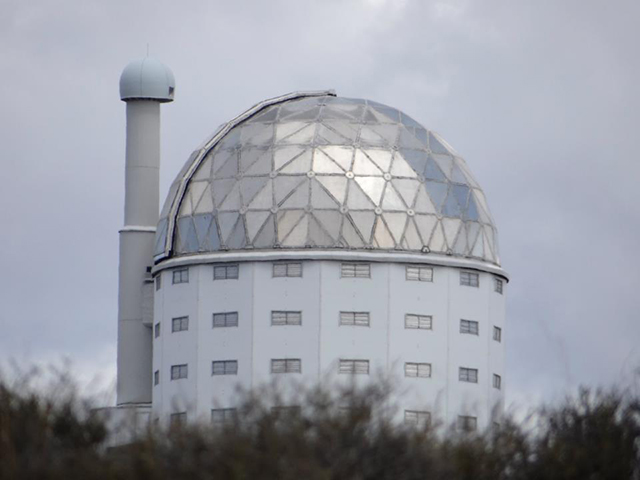
SALT - Southern African Large Telescope

Primary Mirror - Introduction and Layout

Mirror segments
Alignment of the 91 mirrors

The purpose of SALT is to collect light from astronomical objects, accurately focus it onto an image plane, from where it proceeds into an optical instrument while tracking the relative movement of the sky to maximise exposure time. The SALT design is optimised for spectroscopic measurements with median seeing of 0.9 arcsec FWHM (full width half maximum).

A physical layout for SALT is provided in the figure below to show where the Primary Mirror is situated. The design is based on the Hobby Eberly Telescope (HET) in Texas, but deviates in certain aspects to accommodate requirements specific to SALT and to utilise the latest technological developments.


SALT Internal Layout

SALT has a fixed elevation angle of 37° from the vertical and can rotate only about its azimuth axis. This important design aspect allows a significant cost saving in exchange for added complexity of the optical and control systems. The Primary Mirror System is divided into the following sub-systems:

  • Segments
  • Mounts
  • Actuators
  • Truss
  • Alignment Maintenance System
  • Initial Alignment System
  • Coating Plant
  • Mirror Cleaning System